
The verdict: best for patient visual thinkers
Meowdoku’s one-cat placement rules are quick to state and surprisingly rich to combine. The strongest part of the design is the interaction between shaped regions and straight rows and columns. A single placement changes several parts of the board, creating a satisfying sequence of consequences.
It is a good fit if you enjoy making certain moves, writing exclusions and revisiting a position until the reason becomes clear. It is less suited to someone who wants fast action or a puzzle where a guess is always rewarded. This assessment focuses on the rules, official descriptions and the documented tutorial boards in our library.
What works well
- A tiny rule set. You can remember the restrictions without a long manual.
- Visible reasoning. X marks turn deductions into a readable trail.
- Several useful perspectives. A position can be examined by region, row, column or neighborhood.
- Friendly presentation. Cats and colors make abstract placement approachable.
- Transferable skills. Locks and capacity counting also appear in Queens and Star Battle.
Where the experience can become frustrating
A heart system can discourage careless placements, but it also makes learning through trial less comfortable. The store description specifies three mistake chances. A beginner who cannot explain why a move is wrong may benefit more from a diagram or a step-by-step hint than from another attempt.
App versions and events can change the board associated with a level number. An answer found through search is useful only if its region pattern matches. Our walkthroughs therefore pair their analysis with source-video frames.
The official listings identify ads or in-app purchases. The current frequency, offers and available options can vary, so check your release rather than treating a blanket “no ads” claim as a description of every app experience.
Does it become more than a simple placement game?
Yes: the difficulty comes from the shape of the candidate sets. A region can reserve a row before you know its exact cell. Two regions may reserve two columns. Neighboring candidates can share exclusions. These deductions build on the same rules rather than introducing arbitrary new exceptions.
Board size alone does not describe difficulty. A larger board with obvious singles may be easier than a smaller one that needs a careful lock. Study the illustrated strategies if your first scanning routine stops working.
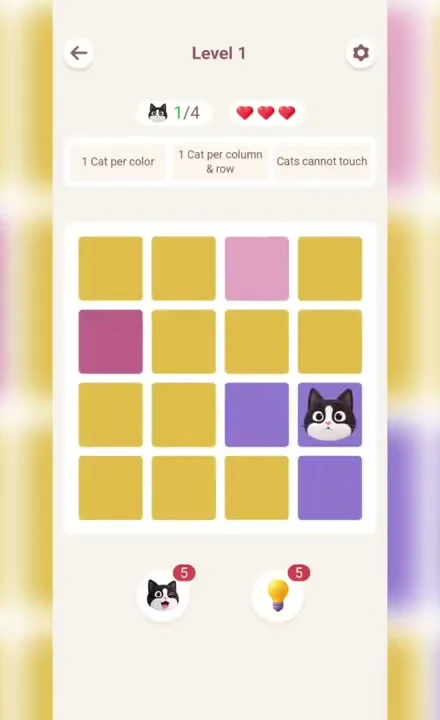
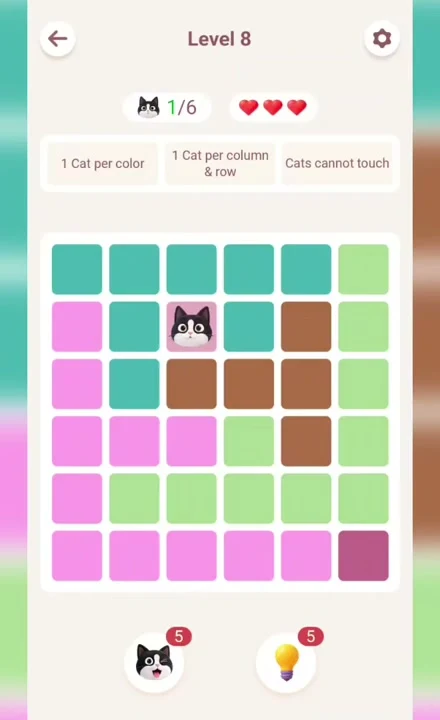
The contrast is visible in our recorded guides. Level 1 gives you two one-cell regions after the starting cat. Level 8 asks you to notice that two brown candidates reserve a column before choosing either one. The same four rules support both a quick beginner placement and a more satisfying indirect deduction.
Who should try it?
You may enjoy it if…
You like visual deduction, keeping neat notes, short sessions and a clear final answer. Sudoku or Queens players will recognise the discipline of eliminating candidates.
Choose another puzzle if…
You want action, elaborate story progression or a puzzle driven primarily by arithmetic. Our alternatives guide compares the different kinds of reasoning.
A good way to begin
Read the rules and controls, then study an early documented level without immediately looking at the final answer. Say the reason for every placement. If you understand the rule but want extra practice, play a small independent Whiskerdoku board.
For the original game and its numbered level progression, use the official app listings. Whiskerdoku supplies independent explanations, documented walkthroughs and browser practice; it is not the app publisher.